5 min read
•
Ecommerce
•
October 22, 2025
Is “Agentic" Commerce really going to be a thing?
Agentic commerce is no longer just theory. Find out what it means, how it fits into Salesforce Commerce Cloud, and how to get your ecommerce architecture ready.
What Is Agentic Commerce?
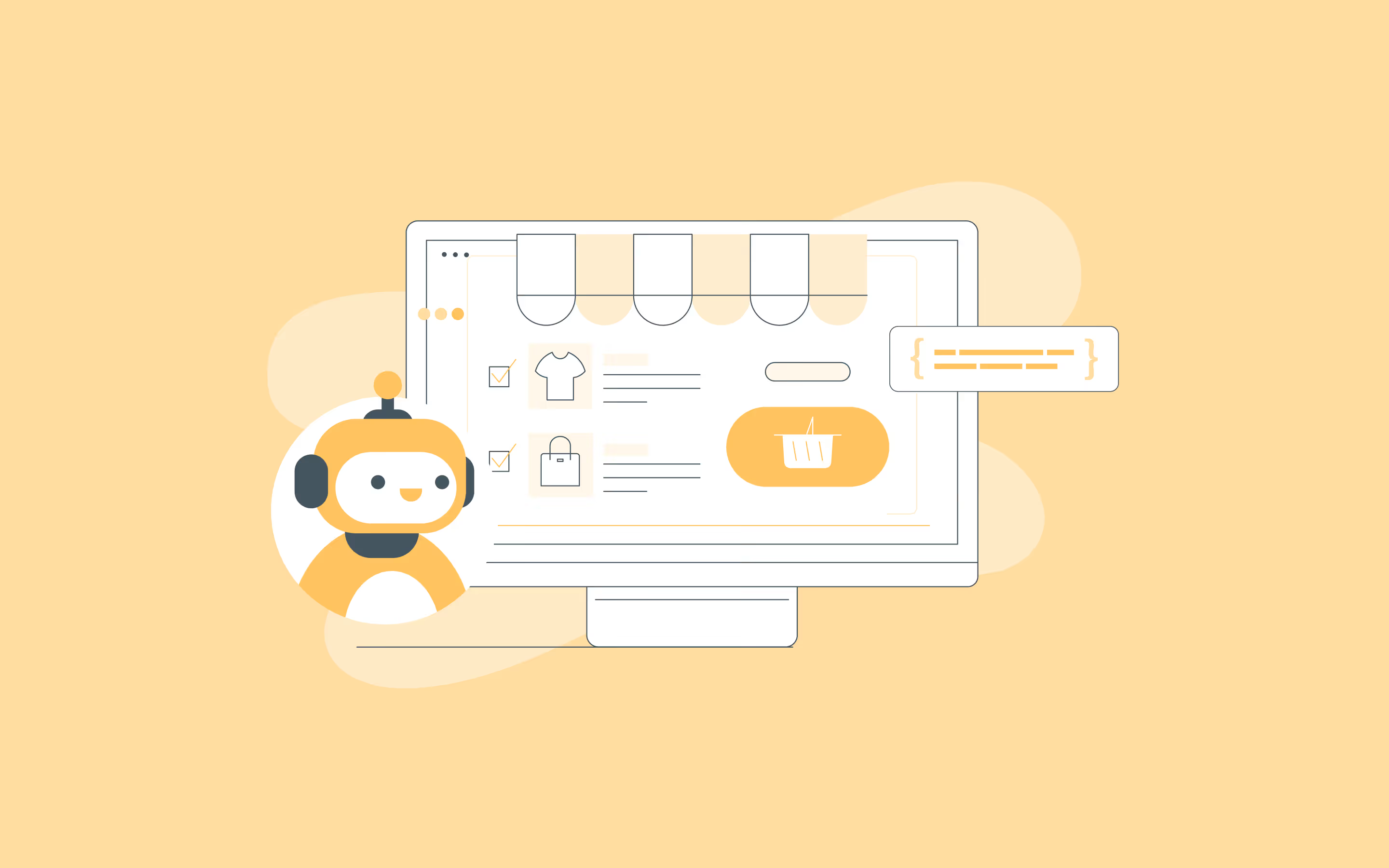
Our industry has a new obsession: agentic commerce - a vision where AI agents not only recommend products but also handle the entire purchasing process for users. Here’s the pitch. What if I could ask an intelligent personal AI assistant what to buy, trusting it to compare options, and letting it complete the checkout. It sounds sleek and frictionless, but the assumption behind it (that humans will eagerly hand over their consumer agency to AI) is far from guaranteed.
Why the Promise of AI Shopping Isn’t So Simple
At first glance, the pitch appeals to our appetite for convenience and precision. Online shopping already overwhelms us with information, reviews, fake listings, and endless choice. If an AI could filter through the noise and make confident, contextual decisions, who wouldn’t want that? The problem is that commerce isn’t only about efficiency, it’s also about trust, control, and self-expression.
The example that gets wheeled out is someone wanting to find a dress for a specific event in a specific place with specific weather. I’d like to buy a comfortable dress to wear in Florida for my sister’s birthday party. Wouldn’t it be great if I didn’t have to go to 12 sites and wade through endless aisles of options?
Maybe. As long as you don’t mind doing your clothes shopping with the most literal person in the world who needs to be given precise instructions to do what you already know how to do, and can do pretty easily with a Google search.
The Emotional Side of Online Shopping
Even in the face of abundant automation, people routinely want to make their own decisions. They browse, compare, deliberate, and reconsider. They abandon carts. They bounce. They return five times to the same item in a month. These actions aren’t inefficiencies; they are part of the emotional texture of shopping. To many consumers, choosing a product is a statement of identity and taste, not just a logistical problem to be solved. An AI silently transacting on their behalf risks hollowing out that personal experience. The very word "agentic" in this context is ironic. Whose agency is actually being exercised?
Trust, Transparency, and the Limits of AI Agents
Then there’s the issue of trust and transparency. No matter how capable large language models become, few consumers will blindly accept that an AI is recommending the best product rather than the one that benefits its corporate partners. The line between recommendation and advertisement is already blurry; agentic commerce could make it invisible. Moreover, once the AI handles spending decisions, it transforms into an entity with power over people’s money. A major psychological and ethical leap that many will hesitate to make.
There’s also a deeper behavioral question: Do people really want fewer decisions, or better ones? Historically, consumers have embraced tools that support decision-making like price-comparison engines, review platforms, and curated lists. Historically, they’ve resisted those that replace it. Even “one-click” buying and subscription models depend on prior explicit consent. Handing that consent dynamically to an AI agent is a different kind of commitment altogether.
The Real Future of Agentic Commerce in Ecommerce
So is this all hype? Probably not. But it might be better to abandon the high-falutin ideas of agents that shop for us in favor of the more prosaic view of AI as one step beyond Google Shopping. Consumers already trust Google to offer up a range of potential buyable items. When a customer writes buy into a query they know what they are asking for and what they will get. Right now, it’s a not very good list of possible matching items. If that got better, if the interaction with the machine was still in my control but it was better at interpreting what I meant, it’s possible to see an environment where I might buy from within the LLM and never go to a merchant site. That’s where I would be putting my money.
In the long run, agentic commerce might find niche adoption, especially in routine, low-stakes purchases. But for most people, the act of choosing remains central to how they relate to both products and themselves. The promise of full AI-driven shopping assumes that consumers see choice as a burden when, for many, decision-making is most of the fun.
{{banner}}

Read more
July 15, 2025
AI & Automation
How AI Is Being Used in E-Commerce And Who’s Doing It Right

October 8, 2025
AI & Automation
Ecommerce
Why AI Personalization Fails Without a Modern, Structured CMS